
How to Choose the Right Gränsfors Bruk Carving Axe.
When stepping into greenwood working, choosing your primary carving axe is one of the most important decisions you’ll make. Gränsfors Bruk has long set the standard for hand-forged Swedish edge tools, developed in collaboration with legendary master craftspeople like Wille Sundqvist.
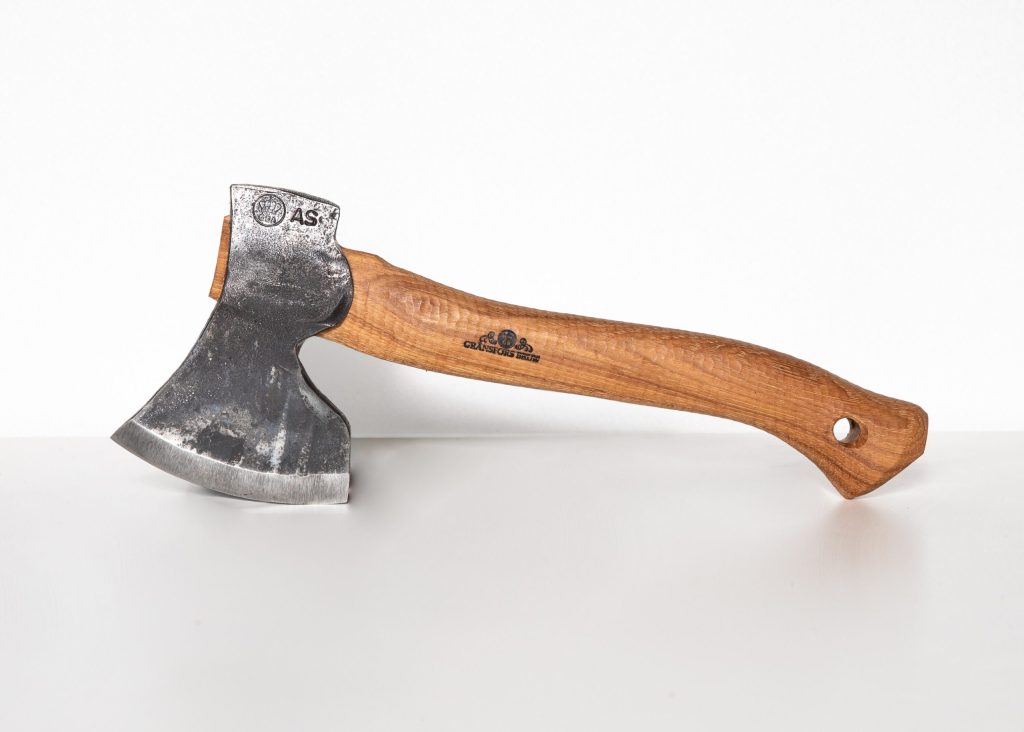
While the iconic Large Carving Axe has been a mainstay in carving workshops for decades, Gränsfors introduced two scaled-down models—the Medium and Small carving axes—giving carvers tailored options based on head weight, control, and project type.
Here is a breakdown of the three Gränsfors Bruk carving axes, how their weights perform, and how to pick the right grind for your workbench.
1. Comparing the Three Axes
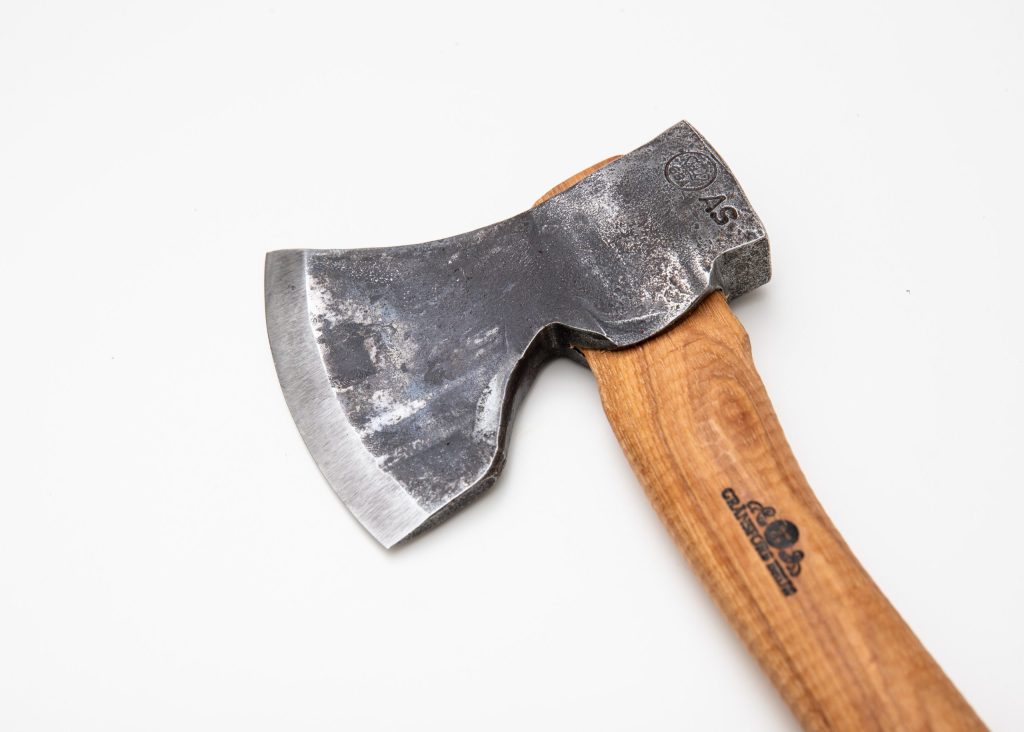
All three axes share the same core architecture: long curved cutting edges, pronounced beards for choking up close to the blade, textured handles for a non-slip grip, and high-carbon Swedish spring steel alloyed with vanadium and manganese for edge retention.
| Model | Weight (No Sheath) | Scale relative to Large | Primary Carving Focus |
|---|---|---|---|
| Large Carving Axe (475) | ~1.0 kg (1000g) | 100% (Original) | Bowl blanks, chair legs, heavy stock removal |
| Medium Carving Axe (472) | ~780 g | ~90% Scale | The All-Rounder: spoon blanking, medium billets |
| Small Carving Axe (471) | ~600 g | ~80% Scale | Spoon carving, fine detail work, long carving sessions |
The Large Carving Axe (~1.0 kg)
An absolute classic in the greenwood community. Weighing in at 1 kg, the Large Carving Axe relies on kinetic mass. When taking a greenwood blank down from a raw log or shaping heavy bowl billets, gravity does a lot of the work for you.
- Best Suited For: Bowl carving, larger timber projects, or carvers who prefer a heavy tool head that drives deep cuts with minimal force.
- Considerations: The extra weight can cause wrist and forearm fatigue over extended carving sessions if you’re still developing your technique.
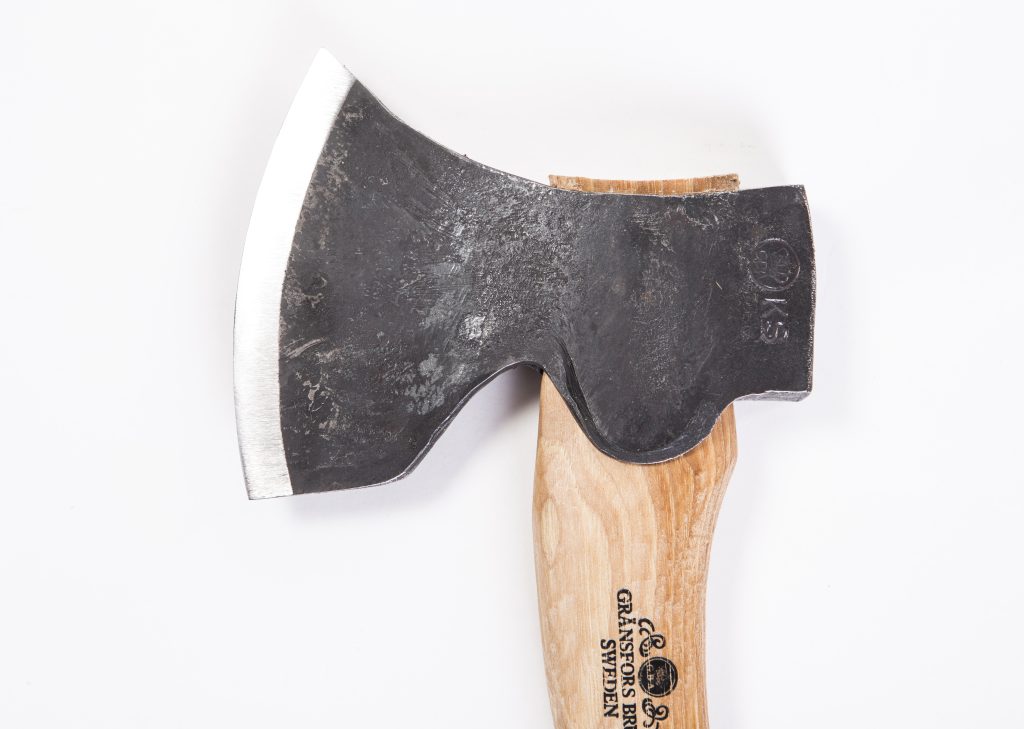
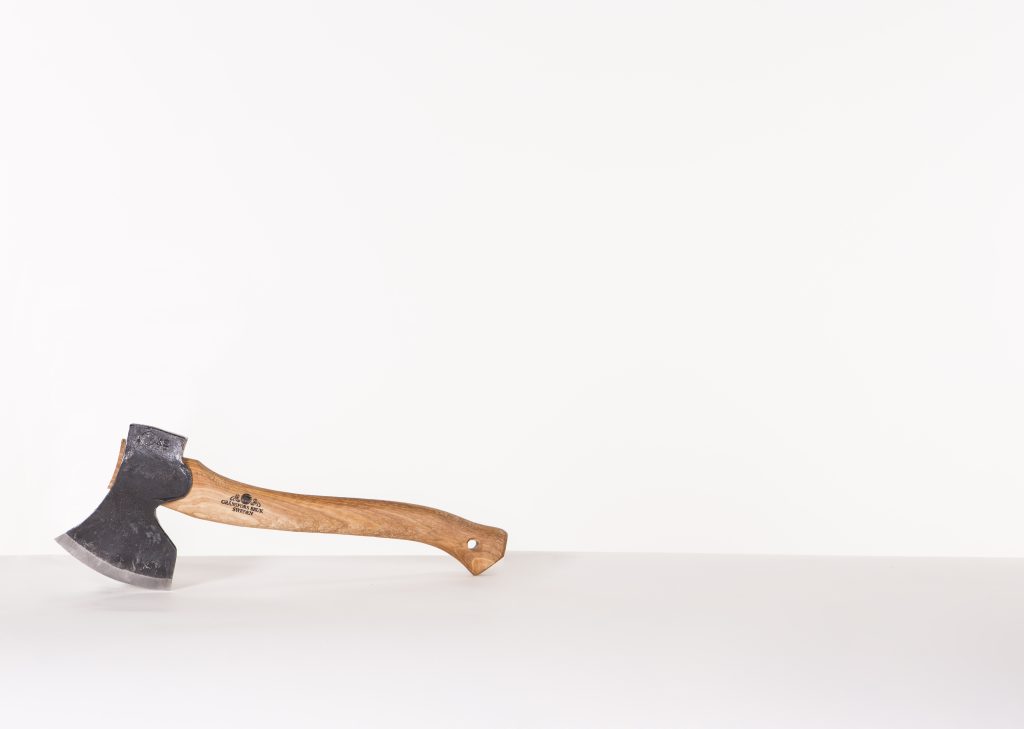
The Medium Carving Axe (~780 g)
Scaled to roughly 90% of the original size, the Medium Carving Axe hits the ideal “sweet spot” for many carvers. It retains enough mass to rough out timber efficiently, but noticeably reduces fatigue during longer work sessions.
- Best Suited For: The ultimate all-rounder. If you want a single axe that offers enough power for blanking timber while remaining nimble enough for detailed cuts, this is the go-to model.
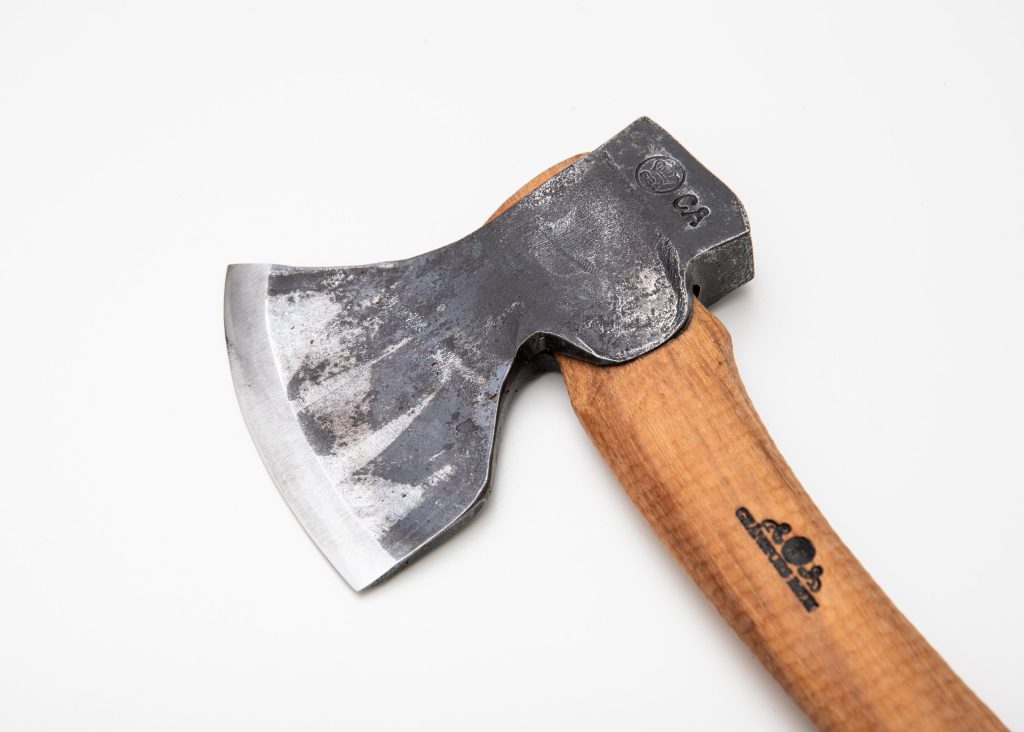
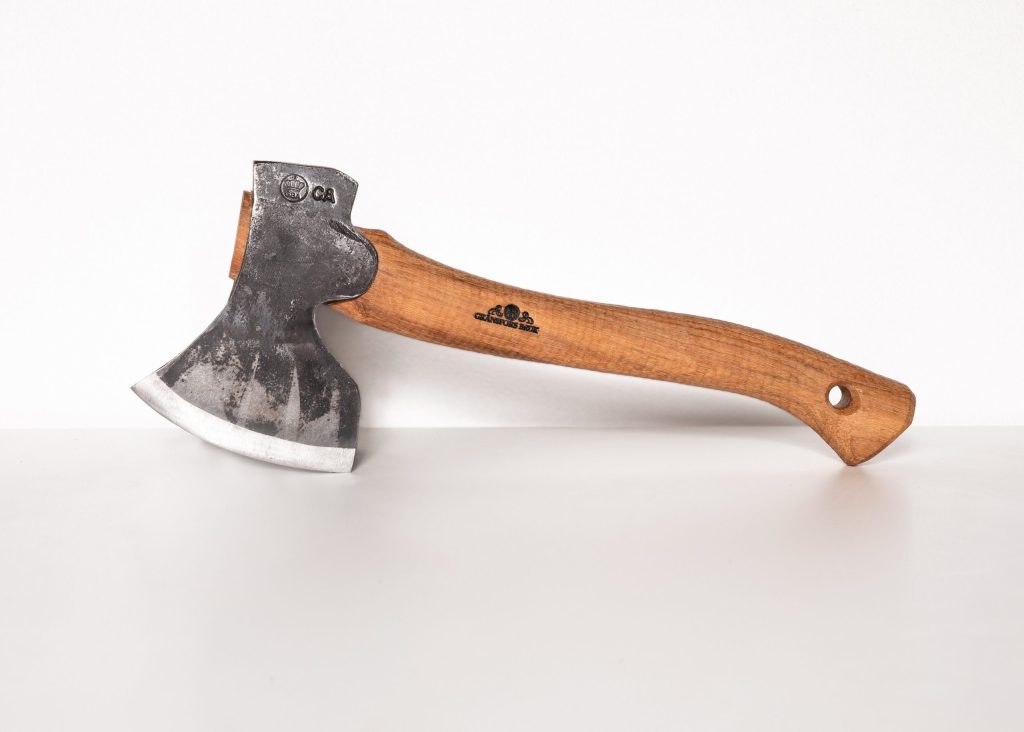
The Small Carving Axe (~600 g)
At 80% scale and weighing 600 grams, the Small Carving Axe is the most nimble and controllable in the lineup. It allows for accurate, directional cuts right up to your layout lines without straining your wrist or shoulder.
- Best Suited For: Dedicated spoon carvers, smaller greenwood craft projects, younger carvers, or anyone who wants to carve for hours without arm fatigue.
2. Choosing the Right Edge Grind
Matching the head weight with the correct bevel grind ensures your axe tracks smoothly through timber.
Double Grind (Symmetrical)
Features gentle convex/flat bevels ground evenly on both sides. This is the most versatile option—ideal for general axe work, shared workshop tools, or carvers who switch between right- and left-handed carving.
Asymmetrical Grinds (Left or Right)
Based on Wille Sundqvist’s original design specifications, asymmetrical grinds feature a long, gently concave primary bevel on one side (which rides flush against the timber) and a short secondary bevel on the other side to push wood chips away.
- Right-Handed Carvers: Need the Left-Ground Axe (the flat/concave bevel sits on the left face, riding flush against the wood when held in the right hand).
- Left-Handed Carvers: Need the Right-Ground Axe (the flat/concave bevel sits on the right face).
Summary Checklist: Which One to Pick?
- Choose the Large Carving Axe (1.0 kg) if you carve wooden bowls, work with heavy logs, or like gravity doing the work.
- Choose the Medium Carving Axe (780 g) if you want one versatile tool for spoon blanks, timber shaping, and daily workshop use.
- Choose the Small Carving Axe (600 g) if you specialise in spoons, want maximum agility, or suffer from wrist fatigue.
- Choose a Double Grind for general versatility or shared workshop use.
- Choose a Single Bevel (Left/Right) for dedicated, flat-hewing performance.
Order online or come info our Chiltern store at 53 Conness Street to see and feel them and even try them out! If you want to try each of the models check ahead that I’ll be in store as I’m often out teaching workshops.
Sign up to my newsletter to keep up to dates with news, workshops, products and more!